The 2011 penny and the coin details can confuse collectors. The date is modern. The mintage is huge. Most pieces are cheap. Can the coin be useful and even valuable?
Early Shield cents are useful for grading coins. They show how red color fades, how spots change appeal, and how ordinary-looking cents can still separate in higher grades. So, let’s explore the coin in detail.
The Design Shift and the Early Shield Years
The Shield reverse started in 2010. That makes 2011 part of the first phase of the new design. It is close enough to the change to feel different from the Memorial years, but common enough to remain easy to study. The reverse uses a Union Shield. The design points to national unity. That change did not create a scarce coin. It did create a cleaner break in the Lincoln cent series. For collectors, that matters. Early subtype years often receive more attention than later routine dates.
The year also sits in a useful place for grading. Billions were struck. Most survived in large numbers. That keeps the lower market quiet. It does not make the upper market automatic. Early Shield cents can still look very different from coin to coin. That is why 2011 works well as a grading-focused article.
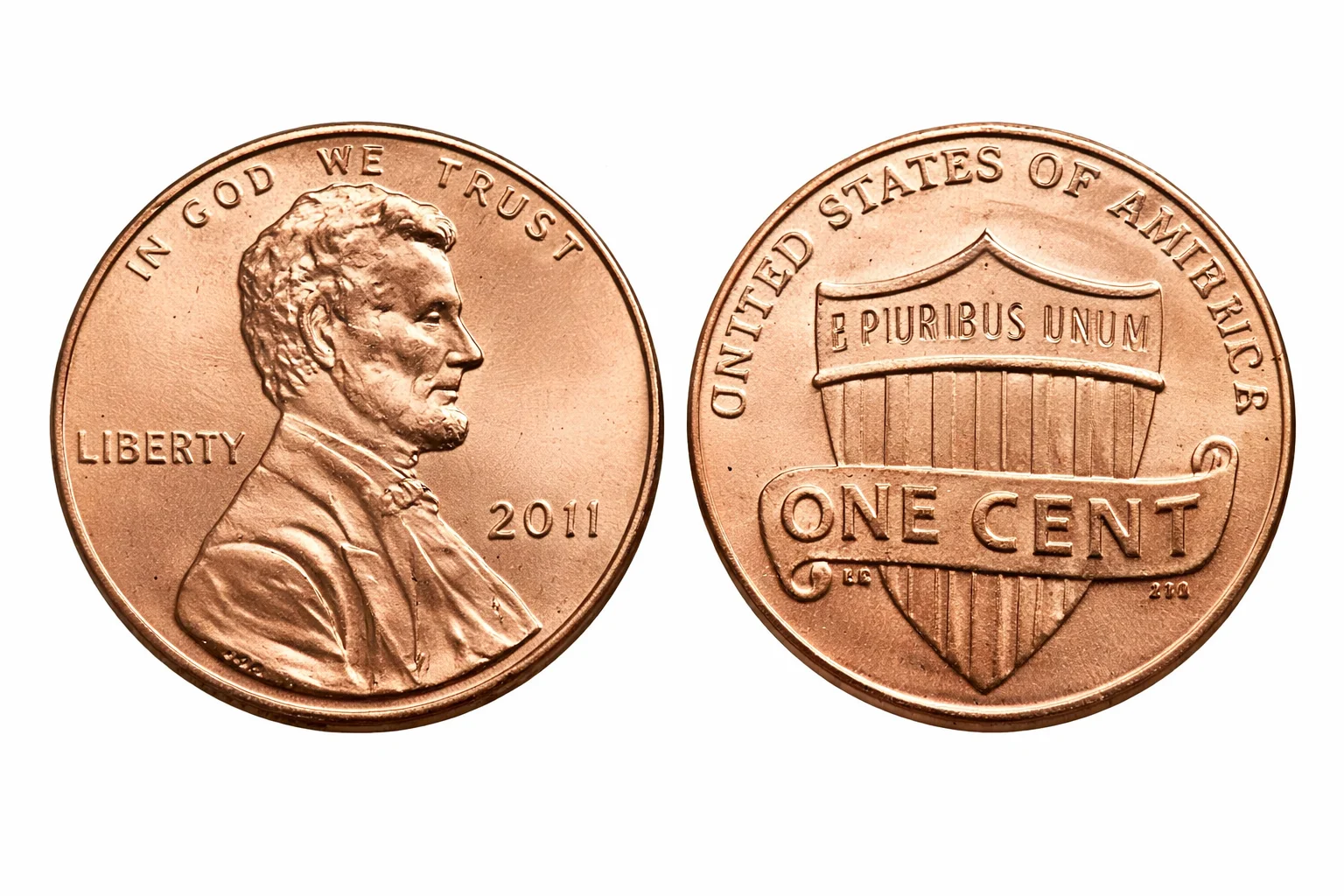
2011 Cents Issued
The first step is simple. Separate the versions before discussing value.
| Type | Mint mark | Format | Main role |
| 2011 | none | business strike | circulation coin |
| 2011-D | D | business strike | circulation coin |
| 2011-S | S | proof | collector issue |
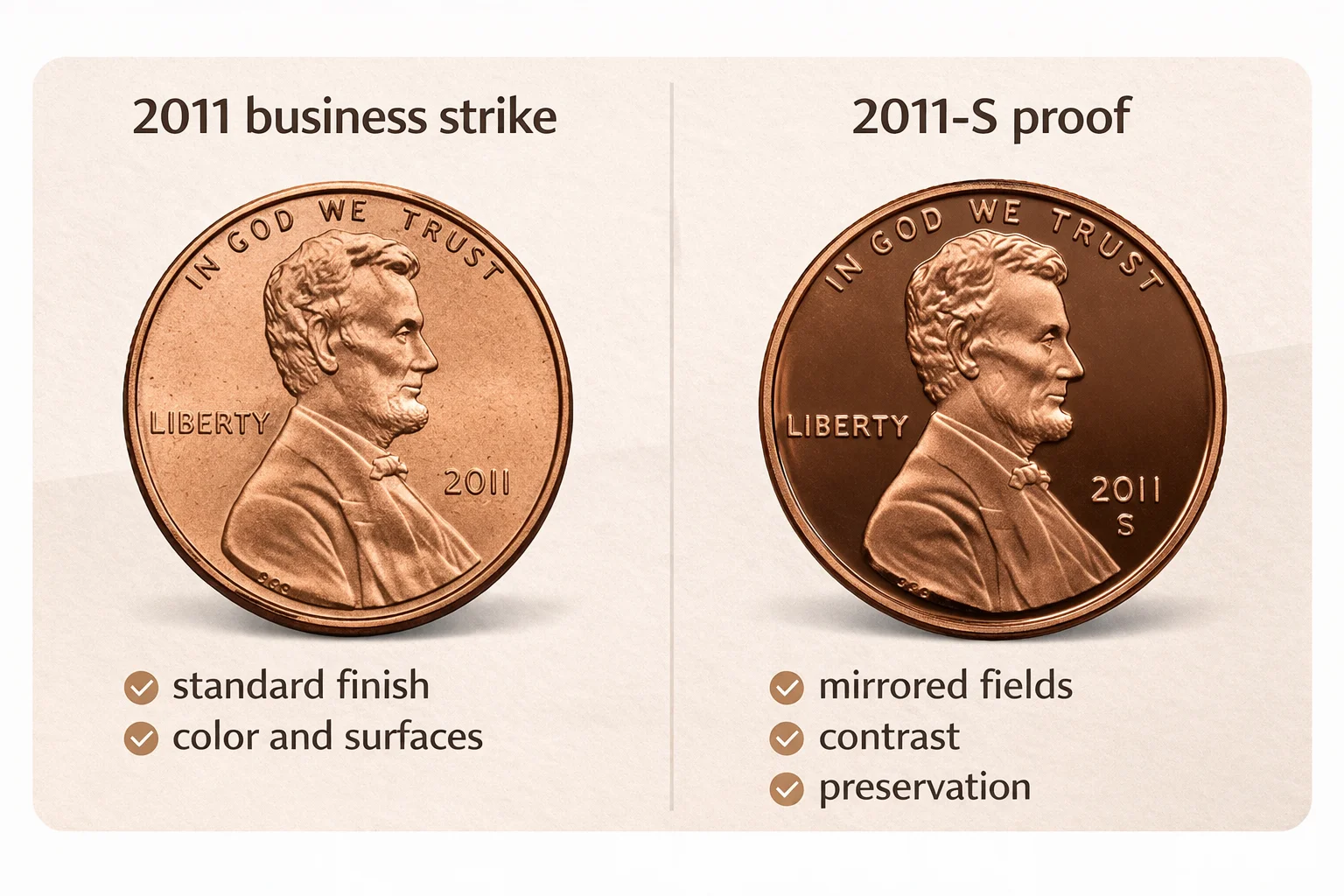
That split matters because the market does not treat all three the same way. The Philadelphia and Denver pieces belong in one discussion. The San Francisco proof belongs in another. A business strike is judged first by strike, color, and surface quality. A proof is judged more by preservation and contrast.
No Satin Finish in 2011
This point is easy to miss. Many collectors remember satin finish cents from the mid-2000s and expect the same thing here. That does not apply to 2011. The United States Mint announced in December 2010 that satin finish would be discontinued and brilliant finish would return for numismatic uncirculated coins beginning in 2011. The 2011 Uncirculated Coin Set followed that change.
That detail matters because it changes how 2011 should be compared with nearby dates. A 2009 or 2010 Mint Set cent belongs to one production story. A 2011 Mint Set cent belongs to another. If a collector does not separate those years, the quality discussion becomes messy very quickly.
Core Specifications
The 2011 cent keeps the standard modern cent specifications. The obverse still uses Victor David Brenner’s portrait. The reverse uses Lyndall Bass’s Shield design.
| Parameter | 2011 cent |
| Composition | copper-plated zinc |
| Weight | 2.50 grams |
| Diameter | 19.00 millimeters |
| Edge | plain |
| Obverse designer | Victor David Brenner |
| Reverse designer | Lyndall Bass |
These parameters are useful. They define the normal coin. They also help when a collector checks an altered piece, a damaged example, or a coin that looks wrong for the year.
Mintage and Supply
The supply is large enough to keep most prices low.
| Type | Mintage |
| 2011 | 2,402,400,000 |
| 2011-D | 2,536,140,000 |
| 2011-S Proof | 1,673,010 |
The two business strikes were made in the billions. The proof was made in much smaller numbers, but it was also saved from the start. That is the usual pattern for modern proof coins. A large supply holds the lower market down. Strong survival keeps ordinary proof pieces from becoming scarce.
Why the Grading Challenge Starts Early
A modern cent looks easy until the collector starts comparing several at once. The 2011 issues teach that lesson quickly. Many coins are bright at first glance. Fewer stay attractive under closer viewing. The difference often comes from color quality and surface freshness rather than from dramatic strike weakness.
A strong 2011 business strike usually shows these traits:
- Brighter, steadier red color
- Fewer spots
- Cleaner fields
- Less distraction on Lincoln’s portrait
- Sharper Shield lines
- Stronger overall eye appeal
This list is basic, but practical. Modern cents do not need romantic language. They need sorting rules. When two coins have the same year and mint, the one with fewer problems usually wins.
Red Color as a Real Market Filter
Red color still matters on a modern Lincoln cent. That often surprises newer collectors. The coin is copper-plated zinc, not a classic bronze Wheat cent, but the market still separates coins by color. Red remains the preferred look at the upper end. Brown and Red-Brown pieces usually fall behind.
| Color term | Meaning | Market effect |
| Brown | mostly brown surfaces | lowest premium |
| Red-Brown | mix of red and brown | moderate premium |
| Red | stronger original red look | strongest collector interest |
This does not mean every Red coin is valuable. It means the better market usually starts there. On a 2011 cent, collectors want more than just a label that says Mint State. They want a coin that still looks fresh. Color helps decide that quickly.
Surface Quality and Everyday Problems
Surfaces decide more coins than the year does. This is where common dates separate from better pieces. A 2011 cent can be technically uncirculated and still look tired. Spots, dull fields, small abrasions, uneven color, and weak visual balance all cut into the grade experience.
Common trouble points on a 2011 cent include:
- Dark spots in open fields
- Uneven plating color
- Dull or washed surfaces
- Small hits on Lincoln’s cheek
- Light abrasions on the reverse shield
- Weak overall balance
These are not rare defects. They are normal modern problems. That is exactly why the grading challenge is real. The coin is common. Truly clean examples are harder to separate than many collectors expect.
A coin checker app can help with basic questions. For example, the Coin ID Scanner can confirm the year, mint, and basic type and value ranges fast. That is useful when several cents are on the desk. It is not the grading step. The grading step still comes from close viewing under stable light.
Business Strikes and the 2011-S Proof
The proof issue belongs in a separate discussion. It was made for collectors, not for circulation. The 2011-S proof came as part of the 2011 Proof Set, which originally sold for $31.95. That gives the coin a different market profile from the start.
| Feature | 2011 business strike | 2011-S proof |
| Purpose | circulation | collector issue |
| Surface look | standard strike finish | mirrored proof finish |
| Main grading focus | color and surfaces | contrast and preservation |
| Lower market behavior | near face value to low premium | modest collector premium |
For the proof, contrast matters more. Collectors often use Cameo and Deep Cameo to describe that look. The terms are simple in practice. Better contrast means stronger eye appeal. On a proof, the market pays attention to that. On a circulation strike, the market pays more attention to red color and clean surfaces.
Value Depending on the Type and Grade
The value spread becomes clearer when the formats are separated.
| Type | Lower range | Typical collector level | Higher-end certified market |
| 2011 regular strike | face value to very low premium | about $0.36 or more in Mint State | selective only in the top Red grades; Greysheet range runs up to about $200 |
| 2011-D regular strike | face value to very low premium | about $0.36 or more in Mint State | selective only in the top Red grades; Greysheet range runs up to about $300 |
| 2011-S proof | modest proof level | about $6.25 or more | stronger only in better DCAM proof grades; Greysheet range runs up to about $25 |
Prices change with grade, color, holder, and timing. The table still shows the main structure. Ordinary business strikes stay cheap. Better certified pieces rise because the grade pool gets thinner. The proof stays moderate unless contrast and preservation are stronger than average.
This is the practical reading of 2011. It is not a high-value date by itself. It becomes interesting when the quality rises above the large surviving base.
Errors and Varieties Found
Errors are not the center of this year. The main market story is still grading quality. That said, specialist references do list doubled die obverses for 2011 Philadelphia cents. Variety Vista shows 2011 1c DDO-001 and a 2011 DDO listings page with more than one attributed obverse variety. These are real specialist topics. They are not the main reason most collectors buy a 2011 cent.
That distinction matters. A mainstream collector should usually focus on quality first. A specialist can move into attributed doubled dies later. For this date, the ordinary market still cares more about red color, clean surfaces, and proof contrast than about a famous variety.
Who This Coin Fits
The 2011 cent works well for several kinds of collectors:
- Lincoln Shield set builders
- Date-and-mint collectors
- Proof set collectors
- Modern graders who study surface quality
- Variety collectors who want an early Shield year
That last point is useful. A very common coin can still teach good habits. The 2011 cent does that well. It teaches separation. Not every bright modern cent deserves the same grade. Not every common year deserves the same attention.
FAQs
Is the 2011 penny rare?
No. The regular Philadelphia and Denver coins were struck in the billions.
Why is 2011 part of the early Shield years?
Because the Shield reverse started in 2010, and 2011 sits at the beginning of that subtype.
Does red color really matter on a modern cent?
Yes. Red still helps separate stronger coins from average ones in the upper market.
Are there 2011 satin finish cents?
No. The Mint ended satin finish and returned to brilliant finish beginning in 2011.
Is the 2011-S proof a better coin than a business strike?
It is a different coin. It belongs to a different market and should be judged by different quality priorities.
Are errors the main reason to collect 2011 cents?
No. The main reason is grading quality within an early Shield year.
Conclusion
The 2011 cent is common. That part is simple. The real grading challenge is not simple. Early Shield years bring more nuance than the mintage suggests. Red color fades unevenly. Spots and dull fields appear fast. Proofs follow a different path from business strikes. That is why the date remains useful to collectors. It shows how quality, not just quantity, shapes the modern market.For a quick first pass, remember to use an app to scan coins for value. But the final call still belongs to the coin in hand.