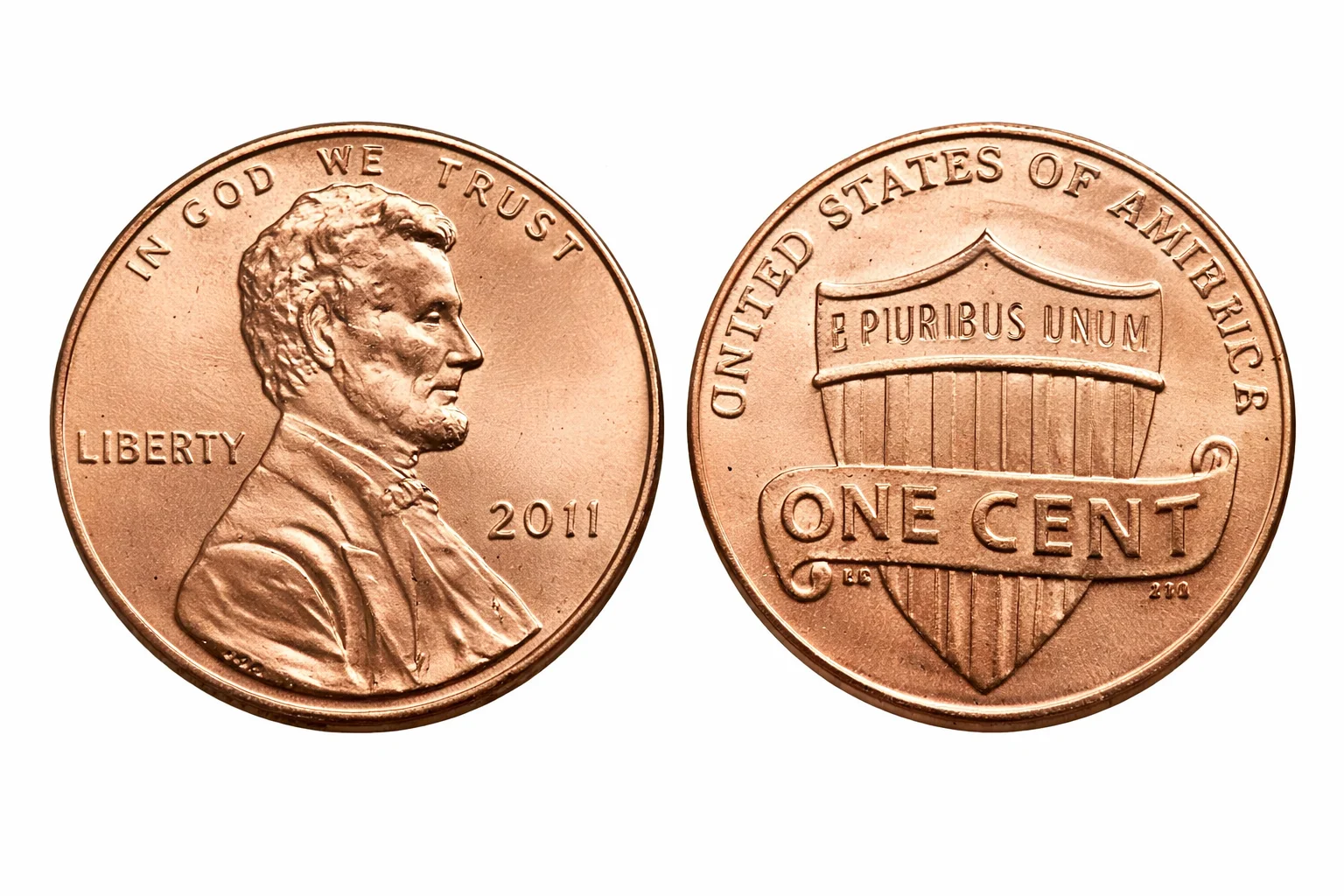
The John Adams dollar coin is one of the most recognizable issues from the U.S. Presidential $1 Coin Program. Now you can often see these coins in collections, online listings, and coin rolls.
Most of these coins are common and worth face value, and only a few contain minting variations, so their price can rise significantly. Do you know how to identify those differences to separate regular circulation pieces from collectible ones?
Overview and Main Characteristics
The coin was issued in 2007 and became the second design of the Presidential $1 series after George Washington. It was created to honor John Adams, the second President of the United States. The coin was issued for general circulation, as well as for collector sets.
| Feature | Description |
| Name | John Adams Presidential $1 Coin |
| Year of Issue | 2007 |
| Mints | Philadelphia (P), Denver (D), San Francisco (S – Proof) |
| Composition | 88.5% copper, 6% zinc, 3.5% manganese, 2% nickel |
| Diameter | 26.5 mm |
| Weight | 8.1 g |
| Edge Lettering | “E Pluribus Unum • In God We Trust • 2007 • Mint Mark” |
| Series | Presidential $1 Coin Program |
| Obverse Designer | Joel Iskowitz |
| Reverse Designer | Don Everhart |
| Face Value | $1 |
The obverse shows a portrait of John Adams, looking right with the inscriptions “2nd President 1797–1801”. The reverse depicts the Statue of Liberty with the word “United States of America” and the denomination “$1”.
The edge of these dollar coins carry the most distinctive feature: inscriptions with the date, mint mark, and national mottos. Errors on this edge are what make certain examples collectible.

Varieties and Minting Locations
Three versions exist, each from a separate mint:
- Philadelphia (P): Mass-production strike. Soft luster, common ones.
- Denver (D): Similar in quantity, sometimes slightly stronger strike quality.
- San Francisco (S): Proof version with mirror fields and frosted details.
Coins from Philadelphia and Denver were released for circulation in rolls and bags, while San Francisco proofs were only made for collector sets. Proof coins have mirror-like surfaces but this fact does not automatically guarantee higher value. Their worth depends on condition, rarity, and market demand.
Although the design is the same, small variations appear in the edge lettering orientation. This creates two position types — Position A (lettering reads correctly when the obverse faces up) and Position B (lettering appears upside down when the obverse is up). Both positions are equally valid, but the distribution differs between mints, adding minor variety interest.
For reference, Philadelphia produced roughly 112 million coins, and Denver struck about 112 million as well. Proof mintage from San Francisco reached just over 3 million. Large totals make most examples common, yet some pieces with visible minting errors can be more valuable than ordinary pieces.
Types of Minting Errors
Errors define whether the dollar coin is collectible or not. Most valuable specimens show faults in the edge lettering process. Each type affects value differently.
- Doubled Edge Lettering
This is the most frequent mistake. It happens when a blank planchet passes twice through the edge-lettering machine. Common subtypes include:
- Overlapped: The second inscription overlaps the first, both in the same direction.
- Position A: Both sets read correctly when the obverse is upright.
- Position B: Both sets appear inverted.
- Inverted: One set upside down relative to the other.
Coins with clear doubling attract collectors because the inscriptions show visible shadowed letters along the rim. Philadelphia issues show this more often than Denver.
- Approximate cost range: $50 – $100 depending on clarity and grade.
- Missing Edge Lettering
Here the coin completely lacks inscriptions such as “E Pluribus Unum,” “In God We Trust,” the date, and the mint mark. This occurs when a coin skips the edge-incusing step after striking. Such pieces are rare, so it should be always verified before sale.
- Approximate market value: $200 – $300+ in certified grades. Some auctioned examples have exceeded these figures when the coin is well-preserved in mint condition.
- Other Errors
Less common variations include:
- Off-center strike: part of the design missing or shifted.
- Weak edge lettering: faint or partial inscriptions.
- Die rotation: slight misalignment between obverse and reverse.
These are usually minor but can still bring $10 – $100 depending on visibility.
Practical tip: Use side lighting or a magnifier to inspect the edge. Ninety percent of valuable John Adams dollar errors appear there. Always handle the coin by its edges to prevent surface marks.
Value by Condition and Grade
You know that condition is almost the first thing that determines the price of any coin. Grading follows the standard Sheldon numerical scale from 1 to 70, taking into account wear, luster, and marks into a clear assessment.
| Grade | Description | Approx. Market Value* |
| Good–Very Fine (G–VF) | Heavy wear, major details smooth | $1 |
| About Uncirculated / MS60 | Slight friction, most luster intact | $2 – $3 |
| MS65 – MS67 | Bright, minimal contact marks | $5 – $10 |
| Proof (S) | Mirror surface, collectors’ issue | $4 – $6 |
| Error Coins | Missing / Doubled edge lettering | $50 – $300 + |
*Average U.S. market estimates, 2025. Always check before buying or selling.
Coins in circulation are rarely above MS60. Uncirculated rolls stored since 2007 can include MS65+ examples, but certification from PCGS or NGC adds credibility and higher resale value.
Advice: Never rely on online photos alone if you are going to buy high value pieces. Remember that all genuine uncirculated or proof coins should be examined by the expert for surface brightness, edge sharpness, and clean rims.
How to Identify Your Coin’s Type and Value
It is important, as correct identification of a John Adams dollar prevents over- or under-estimating its price. So, follow these steps:
- Check the Mint Mark — located on the coin’s edge. “P” for Philadelphia, “D” for Denver, “S” for San Francisco.
- Examine the Edge Lettering — ensure the mottos, year, and mint mark are all present. Smooth edges indicate a missing-lettering error.
- Determine the Orientation — note if the lettering aligns in Position A or Position B. While both are normal, mismatched or doubled text signals a potential error.
- Inspect the Condition — check your coin for surface scratches, dull spots, or discoloration. The fewer marks, the higher the grade.
- Compare with Reliable Catalogs — double check the condition according to PCGS, NGC, or Heritage auction archives to confirm current pricing levels.
And remember that digital tools simplify this process. Coin ID Scanner can identify the coin’s type, year, and mint automatically from a photo and store it in a digital collection. This is useful for cataloging before professional grading or insurance documentation.
Once basic identification is done, weigh and measure the coin to make sure the parameters match those stated specifications. Deviations in weight can show you have striking errors or planchet issues.
Is John Adams Dollar Coin Worth Collecting and Investment
Collectibility
The John Adams dollar is a central part of the Presidential $1 series. Collectors often gather full chronological sets from Washington to Reagan. Including the Adams issue is necessary for a complete sequence.
Proof coins and verified mint-error pieces are the most desirable. Standard circulated examples are inexpensive but fill thematic or educational gaps in U.S. modern coin history. The coin in general is affordable, which makes it a good entry for new collectors learning grading and edge-lettering nuances.
Investment Value
From a financial standpoint, this coin has limited profit potential in bulk. The mintage is high, and most pieces trade close to face value. However, certain categories retain value over time:
- Certified MS67+ coins: Scarce in flawless condition, occasionally reach $20 – $40.
- Proof 70 (S-mint): Top-graded proofs may sell for $25 – $30.
- Edge errors: Genuine missing-lettering or strong doubling examples can achieve $200 – $300+ and maintain steady demand.
These prices are small compared with rare silver or gold coins but consistent within modern U.S. numismatics.
Investors rarely focus on this issue, as its market is driven by collectors, not by investment growth.
Market Perspective
Auction records show small but steady movement. Certified missing-lettering coins Auction results show minor but steady activity. Certified coins with missing lettering appear often and usually sell for $200–$350 depending on condition. Proof versions stay easy to sell because they come in official Mint sets.
Practical view
When you hold many coins, grading makes sense only for top-quality or error pieces. Focus on uncirculated rolls or verified edge errors. Regular circulated coins have almost no resale profit. Most collectors keep the John Adams dollar for its historical context, not for investment.
Final Points
The John Adams dollar coin remains widely available, yet careful examination can reveal rarer forms. Edge-lettering variations, doubled or missing inscriptions, and smooth-rim errors are the main sources of high value.
Condition and certification multiply this value, while mint marks and orientation help confirm a coin’s authenticity. Modern collectors combine physical inspection with digital documentation, making sure each find is accurately recorded and stored.